
PENTAHOLIC
SKETCHPAD SYNTH
The Sound Engine
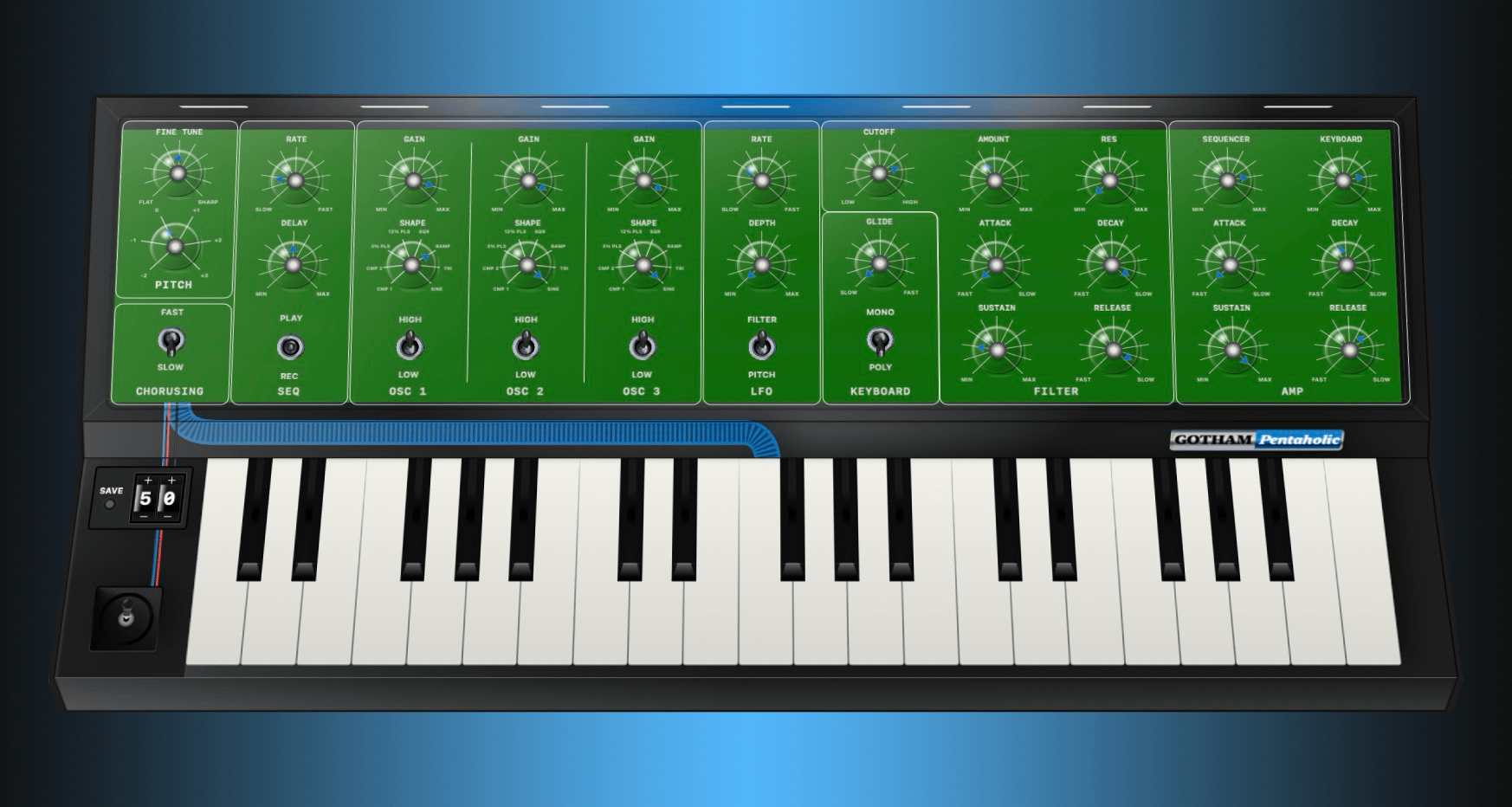
In 1982, the Gleeman Pentaphonic was released as a "sketchpad synth" with a 300-note polyphonic sequencer boasting 5 voices, 3 digitally controlled oscillators per voice, and 8 waveforms per oscillator, all from an 8-bit microprocessor. After DAC, a trio of CEM chips per voice passes the audio: a 3310 envelope generator, 3320 configured as a 24dB low-pass resonant filter, and a 3360 as dual voltage-controlled amplifiers.
Pentaholic brings the circuit to life in the digital realm for the first time ever on any platform. Component-level modeling captures the soul of the synth - a 24dB resonant low-pass filter - self-oscillation, and nonlinear harmonic drive of the legendary CEM 3320 filter chip for a distinct bite with each subsequent gain stage pushing into saturation through a LM348 op amp.
True chorusing detune
Oldest note first voice stealing
8 waveforms (CMP1, CMP2,
3% & 12% PULSE, SQR, SAW, TRI, SIN)
HIGH or LOW octave mode
Precise, vintage-snappy contours
Resistor-capacitor networks modeled

The Polyphonic Sketchpad Sequencer
The concept of a sketchpad synth was the main inspiration for this - getting back to the fundamentals of songwriting and sound design. Pentaholic is meant to inspire ideas faster and prevent Producer Paralysis induced by too many options on the piano roll.
Record your idea to the sequencer and play over it - the keyboard takes precedence over the sequencer notes so you can nail down your melody or adjust your groove with the rate and delay of the sequencer.
Real-time chord recording
Transpose like a guitar capo
Modern Advances
Pentaholic honors the original but Gotham Paradise recognizes the value and convenience of advances for performance available from soft-synths, MIDI 2.0 and Bluetooth.
